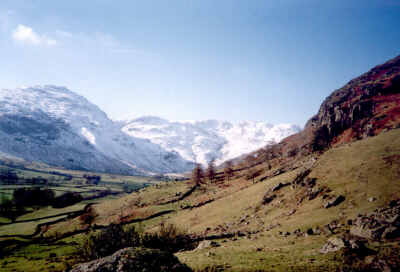
Britain's upland environment is scenic but fragile. Large numbers of hill walkers and other users on particular paths, combined with an often meagre and heavily grazed vegetation cover, have resulted in serious erosion problems, especially in the most popular mountain areas. In the 1980s a variety of repair and management solutions was tried, some of which were controversial and employed intrusive engineering techniques and inappropriate materials more suitable to lowland or urban environments.
The British Mountaineering Council (BMC) conducted an extensive study into the issue and, in 1990, launched the BMC's Upland Footpath Repair Policy which set out clear principles for the style and methodology of path repair to be in keeping with the upland environment. Further consultation concluded that a Trust should be established to promote this policy. The BMC, the Ramblers Association, the Mountaineering Council of Scotland, and the Camping and Outdoor Leisure Association (the trade association of outdoor equipment manufacturers) together became co-founders of the British Upland Footpath Trust (BUFT), and in 1994 the Charity Commission gave formal clearance for BUFT to be established as a charity.
The Upland Footpath Repair Policy has been further developed in association with the Lake District National Park Authority, the National Trust and English Nature. The resulting 'Upland Path Erosion Guiding Principles' were endorsed by the House of Commons Environment Select Committee in 1995, and the Countryside Commission has been charged with promoting them in England (see below).
The Trust's overall aim is to "improve the quality and standard of footpath work and maintenance in the uplands". More specifically, the objectives which guide BUFT's current work are to:
- Promote the Upland Path Erosion Guiding Principles amongst all those involved in upland pathwork and management.
- Raise the profile of pathwork amongst land managers, users and funding bodies, and increase awareness of the need for adequate base level resourcing and funding for upland path repair and maintenance.
- Create a forum for the sharing of ideas, techniques and information in relation to the repair and maintenance of upland paths.
BUFT seeks to advance these objectives through a variety of initiatives to raise awareness of the Guiding Principles amongst pathworkers, managers, funding bodies and users.
Current initiatives include:
'Mending our Ways; the quality approach to managing upland paths'
In 1998 BUFT published its new illustrated booklet 'Mending our Ways; the quality approach to managing upland paths'. The publication builds on the Guiding Principles and emphasises the importance of commitment and understanding from all involved in upland path management - including funders, path workers and users - to achieve consistent good quality upland path management. 'Mending our Ways' has two main purposes:
- To remove the policy, funding and management barriers to achieving quality path work and to change thinking on important issues
- To ensure that the important qualities of good path work can be put into practice and be readily recognised by funding bodies and upland managers.
To read an on-line review of Mending our Ways click here
Upland Path Conferences
BUFT has run two major conferences (in 1996 and 1998) for upland pathworkers and other professionals in the field. These have provided valuable opportunities to exchange ideas and learn new techniques and information about pathwork. The conferences have included presentations, site visits and workshop discussions, and have been supported by delegates from across Britain and Ireland.
Upland Path Information Network
BUFT is creating a forum for the sharing of new ideas, techniques and information through the Upland Path Information Network. This informal Network is currently being developed and will be run and supported by BUFT. Anyone interested in joining the Network should contact the BUFT Office.
Upland Path Award
BUFT has run two Upland Path Awards (in 1996 and 1997) to promote and acknowledge best practice in path repair. These have attracted good support and have proved to be an innovative way of raising awareness of quality path repair with users and pathworkers, helping spread new ideas and initiatives amongst practitioners and giving recognition to all those involved in quality upland path restoration.
Awards were made as follows:
1996 The Breast Route on Great Gable; also Cribyn on Brecon Beacons, and Coire Lagan, Skye.
1997 The Jenny Brewster Path, Cleveland Way; also Gamlin End, Buttermere, Ben Lomond and Coire Mhic Fhearchair, Torridon.
Colour reports detailing all the entries for each Award are available from the BUFT Office.
The Trust was established with start up funds from the founder organisations and the Countryside Commission. In 1994 a funding bid to a private trust, the Alec Grant Trust, was accepted and BUFT received �110,000 to fund four major path repair projects. These projects were:
- Coire Lagan on Skye, completed by Pathcraft on behalf of the Skye & Lochalsh Footpath Initiative
- Redacre Gill, Langdale, completed by The National Trust in partnership with the Lake District National Park Authority
- Losehill in the Peak District, completed by The National Trust
- West Face of Tryfan, completed by The National Trust
Further major donations have been received from supporters including Berghaus, Wild Country, Gronell (UK), The Scheme Trust and Contour Holidays (Cumbria).
BUFT currently relies for core funding on the founder organisations and the Mountain Leader Training Board, and also on numerous small but very welcome donations from individual hillwalkers.
Repairing and maintaining eroded paths is extremely expensive (between �25 and �70 per metre), very labour intensive and a highly skilled job. Currently upland path erosion rates far exceed maintenance programmes. For example :
- 19 km of paths in the Snowdonia National Park are currently suffering from severe erosion problems
- Over �4 million has been spent on footpath repair on the Pennine Way over the last 8 years
- At least �1 million a year needs to be spent to keep pace with the erosion problem in Scotland
- Approximately �4.2 million was required in 1998 for repairs needed on the Lake District fells, not accounting for any new or emerging erosion work
BUFT is not at present directly involved in funding pathwork. BUFT initiatives help to ensure that sustained work in restoration and maintenance is of the quality which our upland landscapes deserve. BUFT welcomes the interest and support of hillwalkers.
Susanna Perkins
Secretary, British Upland Footpath Trust
PO Box 96
Manchester M20 2FU.
Tel: 0161 445 4747
Fax: 0161 445 4500
e-mail: [email protected]
The following principles have been formulated by the Lake District Upland Access Management Group, adapted from the BMC policy statement on the repair and management of upland paths. They have been accepted and adopted by the House of Commons Environment Select Committee (in 1995) as the best practice guidelines to establish a nationwide approach for the repair and maintenance of upland footpaths.
The repair and maintenance of paths in open country are subject to the following considerations that:
- Repairs are necessary to prevent or ameliorate visual intrusion and environmental damage.
- Works should be of a high standard of design and implementation using indigenous materials, sympathetic in colour and texture to the immediate surrounding area. Uniformity of construction should be avoided e.g. steps
- Techniques used should protect existing vegetation and, normally, only locally occurring plant species should be used in restoration. Non local species will be accepted only where necessary as a nurse crop and where natural succession will rapidly result in their disappearance.
- The more remote the path, the more stringently the criteria for path repairs should be applied. This will be a matter of judgement but in general, the more remote or wild the location the less acceptable an obviously engineered path will be.
- Repaired paths should be suitable to the routes use and constructed on a scale appropriate for the intended use as a footpath, bridleway or byway.
- Before any repair work is agreed the question should be asked 'is there a better solution?'
- The use of waymarks, cairns or other intrusive features, other than those traditionally established on summits and path junctions, will be discouraged.
- A sustained commitment of resources to path management will be sought, so that small scale continuous maintenance can replace infrequent major repairs as the normal method of path management.
Repairing Upland Path Erosion (1996) by Jim Loxham and Peter Davies. Available from The National Trust Estates Office, 33 Sheep Street, Cirencester, Glos GL7 1RQ. Price �18 + P&P.
The following are available from the BUFT Offices:
Upland Path Award Report 1996. Price �10
Upland Path Award Report 1997. Price �12
'Reaching For New Heights' Conference Report (1998) Price �7.50
'Mending Our Ways'; the quality approach to managing upland paths (1998) Price �5