Karibuni (Welcome to)
Bermi Village
Tanzania
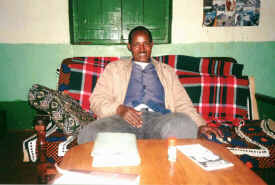
Gervais Sangka, age 45, is the Mwenyekiti (chairman) of Bermi village since 1977.
Karibuni (welcome) Bermi!
"Bermi is an agricultural village. We raise maize, beans, cow peas, wheat and finger millet. We have pursued development ourselves. We have advanced with our own strength and work. We built a piped water system in 1974, a primary school in 1977, and a church in 1978.
We are doing a lot of work to protect the environment - especially planting trees on our farms, and we raised and planted 16,000 trees on the Rift escarpment. People are very happy to work together in this environment, as seen when work was being done on the Rift trails and our soil conservation projects.
Electricity is coming this year, but hunger is fierce and the rains are very late. Bermi is like a family and we have love for all people"
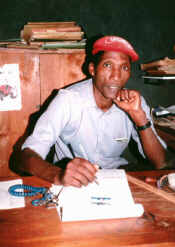
Daniel Sangka was the Village Secretary for many years and is now in the next village, Seloto.
"There are many problems in Seloto and I will do my very best to help the people there."
He will return to Bermi as he had to promise the community he would return before they gave him permission to move.
Daniel is from one of the largest families in the area. His grandmother and his great grandmother each had thirteen daughters, and lived more than 120 years. Although his family is very large he knows the life stories of his relatives going back twelve generations.
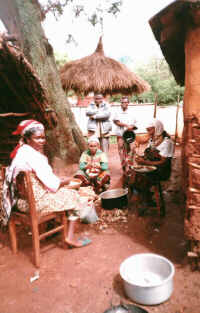
As you would expect in a well run village, there's a woman involved!
Mama Mary is the Ward secretary responsible for Bermi and the neighbouring villages of Seloto and Dareda Kati.
Recently, the president was touring the area, Mama Mary thought he should stop in Bermi and say a few words, even though his schedule was full.
So, when the Presidential motorcade came into view she got all the village women to block the road and politely requested that the President have a look at the work the villagers have done and say a few words. He did so, but Mama Mary thought he didn't say enough, so she made him promise to visit again on his way back.
On his return she once again blocked the road, and the President got out and made a longer speech before he was allowed on his way. There aren't many countries where you can get away with this!
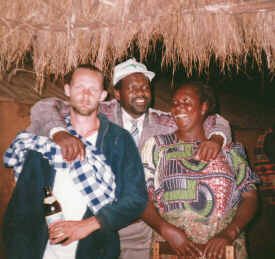
Mama Mary also runs a caf� bar, and is shown here (above), with Joseph Magwe, Farm Africa administrator and Andy Carling, Farm Africa footpath consultant, who has been in the bar for some time...
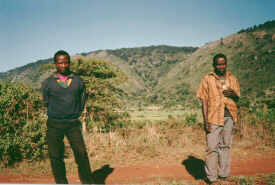 Vicenti
Tiofili and Maneja with the irrigated fields behind them. Farming is difficult in Bermi,
last year brought El Nino, and this year brings drought.
Vicenti
Tiofili and Maneja with the irrigated fields behind them. Farming is difficult in Bermi,
last year brought El Nino, and this year brings drought.
Very few fields are irrigated and most are lying idle until the rain comes. Vincenit "We had some good rain so we worked the fields and the corn sprouted. It hasn't rained since and the corn is wilting.
Unless it rains in the next few days we will lose all our crop."
It hasn't rained and probably won't until the end of the year.
People are stoical about this, but they know that desperate times are in the near future. The village has no money, the grain stores are empty and there's nothing growing in the fields. Their only chance of getting through this is their own sense of community and tradition.
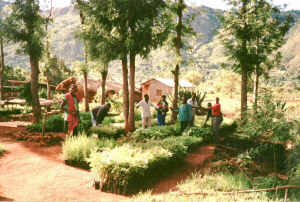
The village tree nursery produces over 10,000 trees a year. Each one is watered
daily and cared for individually.
In charge is Eusebi Paulo "This is good work because it helps us raise wood for building, firewood, fruits and fodder."
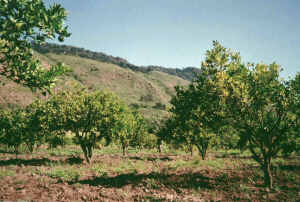
Mzee Willybrodi has been practising agro forestry since he was taught grafting as a child, and his farm includes oranges, tangerines, lemons and plums.
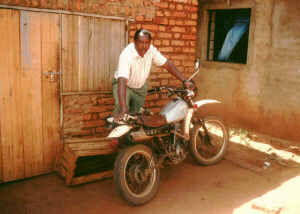
James Andrew, age 44 is a leading figure in the village
"I was born in Bermi, and have two plots of land. I'm a farmer, a steel engineer, a
father and a businessman.
Life is tough right now because of the weather. We farmers depend on rain, but we don't have any irrigated farms. There's water in the river, but no means to bring it to our farms"
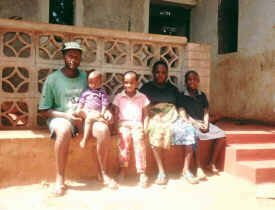
Ephraim Lukamay, age 37, is a Maasai from around Mount Meru and he moved to Bermi in 1992 to head Farm Africa's goat programme.
"My major interest is in zero grazing because I look at the land pressure and land use. I see myself raising poultry, dairy cows and smaller animals because they are easier to manage."
Lukamay's family moved here to join him. "Bermi is a good place to raise a family. In traditional Africa we men inherit land from our fathers, but I was fortunate to obtain this land myself. I'm holding my son Ola, we built the foundation of my house the day he was born."
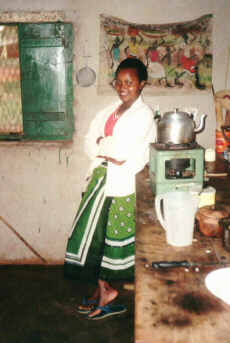 Josephine Yohhan
is a newcomer to Bermi. She was born in a nearby village and moved here to work.
Josephine Yohhan
is a newcomer to Bermi. She was born in a nearby village and moved here to work.
"I like Bermi because the people are nice and I'm happy with them."
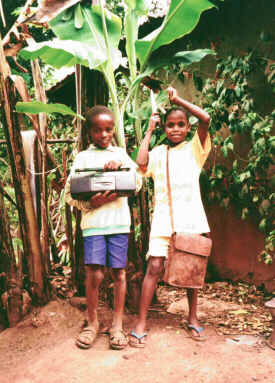 Geraldi 'Kaka'
Christian and Danieli John, eleven and twelve years respectively, are firm friends from
different tribes.
Geraldi 'Kaka'
Christian and Danieli John, eleven and twelve years respectively, are firm friends from
different tribes.
Kaka is Chagga and Danieli is Iraqw. Danieli is holding the knife to represent the careful pruning of banana trees to induce good production and proudly wearing his school satchel.
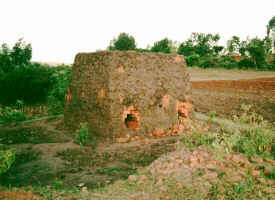
This is a brick factory.
Fine dirt is mixed with water and compressed individually into a mould. After being left in the sun to dry they are carefully stacked in an exact fashion.
The two holes at the bottom are for firewood.
The whole kiln is sealed with mud and the fires lit. It burns for 24 hours and left for a week to cool down, after which the bricks are ready for building.
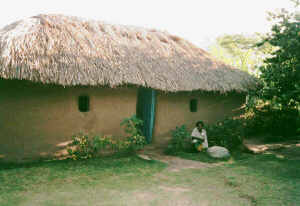
Marie Hhayuma sits outside her house, built in 1975 from a wooden frame and finished with mud plastering. The grass roof needs rethatching every three to five years.